Creating the perfect home theater experience starts with choosing the right projector, and one of the most important features to consider is projector lumens. Whether you’re planning a cozy dark room or a multi-purpose living room with some ambient light, understanding how bright your projector should be is essential for clear, vivid images.
This comprehensive projector lumens guide will walk you through everything you need to know to answer the question: How Many Lumens Do I Need For A Projector?
Understanding Projector Lumens
Projector lumens refer to the brightness of a projector. The term “lumens” measures the total amount of visible light emitted by a source. For projectors, a higher lumen rating generally means a brighter image. However, brightness needs vary depending on the environment and screen size.
There are different types of lumen measurements:
- ANSI Lumens: The industry-standard measurement for projector brightness
- LED Lumens: Typically used for LED projectors, but not directly comparable to ANSI
- Peak Lumens: Less accurate, usually higher than real-world performance
When shopping for a projector, always look for the ANSI lumens rating for the most accurate representation of brightness.
Projector Lumens Chart for Home Theater
Room Lighting Condition
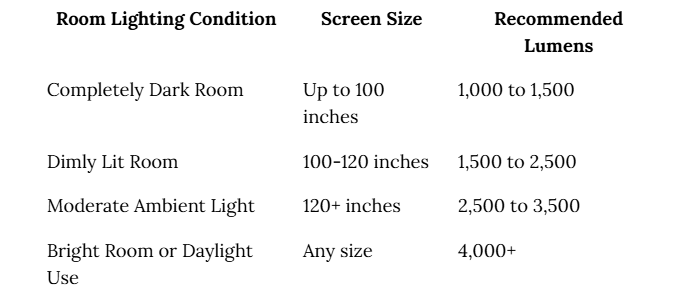
Use this projector lumens chart as a baseline when evaluating different options.
How Many Lumens Should a Projector Have for a Home Theater?
For a dedicated home theater room with good light control (blackout curtains or no windows), a projector with 1,500 to 2,500 lumens should be sufficient. This range offers a balance of brightness without washing out the image or causing eye strain.
However, if you’re setting up in a space with more ambient light, you may want to consider 3,000 to 4,000 lumens.
How Bright is 4,000 Lumens?
A projector with 4,000 lumens is considered very bright. It’s suitable for rooms with considerable ambient light or for projecting a large image. However, using 4,000 lumens in a completely dark room may result in overly bright images and reduced contrast.
How Many Lumens Does a Projector Need for Daylight?
Using a projector in daylight requires higher brightness levels to counter the natural light in the room. The minimum recommendation is:
- 3,500 lumens for shaded daylight
- 4,000 to 5,000 lumens for full daylight exposure
If you’re wondering how many lumens for daytime projector, look for models specifically designed for high-brightness performance.
Best Projector for Bright Rooms
If you’re using your projector in a living room or space with windows, choose a projector with high brightness and good contrast. Some of the best projectors for bright rooms include:
- Epson Home Cinema 3800 (3,000 lumens)
- BenQ TK850 (3,000 lumens)
- Optoma UHD50X (3,400 lumens)
These projectors are ideal for living rooms and multi-purpose spaces where ambient light is unavoidable.
How Many Lumens Is Good for a Projector in a Home Cinema?
For a true home cinema installation, your goal is to replicate the dark, immersive feel of a commercial theater. In such controlled environments, 2,000 to 2,500 lumens is often ideal. It offers enough brightness without sacrificing contrast or black levels.
Common Questions: Why Is My Projector Blurry?
If your projector image is blurry, it might not be a lumen issue. Common causes include:
- Incorrect focus settings
- Low resolution output
- Dirty lens
- Misaligned projector or screen
- Using a wall instead of a projector screen
While projector lumens impact brightness, they don’t directly cause blurriness. However, insufficient brightness in a bright room can appear blurry or washed out.
Projector on Wall vs Screen: Does It Affect Brightness?
Yes. A proper projector screen reflects light more efficiently than a plain wall. Using a wall can absorb light and reduce perceived brightness. So even if you have a high-lumen projector, using a screen will give you better results.
If you’re comparing wall vs projector screen or wondering about projector on wall vs screen, remember: screens are optimized for color, contrast, and brightness.
How to Choose the Right Brightness: Projector Lumens Guide
When determining how many lumens is good for a projector, ask yourself the following:
- How big is your screen? Larger screens need more lumens.
- How much ambient light is in the room? More light requires higher lumens.
- Do you want to use it during the day? Go for 3,500 lumens or more.
- Do you have a projector screen? Screens reflect better than walls.
- Is it for movies or presentations? Movies need good contrast; presentations need clarity.
This projector lumens guide helps match your environment to the ideal brightness.
Conclusion
Choose the right lumens projector based on your room conditions, screen type, and content usage. Whether you’re watching movies, gaming, or hosting presentations, the right brightness makes all the difference.
In the end, finding the best projector lumens for daylight or nighttime viewing comes down to balancing brightness, contrast, and environment. Let this guide lead you to the ideal home theater setup with vivid visuals and unforgettable experiences.
If you’re still asking How Many Lumens Do I Need For A Projector, here’s a quick recap:
- 1,000 to 1,500 lumens for small screens in dark rooms
- 2,000 to 2,500 lumens for average home theaters
- 3,000 to 4,000 lumens for brighter rooms or larger screens
- 4,000+ lumens for daylight viewing or outdoor setups